Botany & conservation
Rathamilla mangrove
Meet Lumnitzera littorea, the red-flowered mangrove, and discover the research behind its conservation in Sri Lanka.
Read the guideMadu River guide
A Madu River boat safari gives you a different view of the wetland. Look along the waterline for birds, notice the roots beneath the mangroves and take time to watch what moves between the branches. A quieter pace helps you enjoy the smaller details as well as the wider river scenery.
Kingfishers, herons, egrets and cormorants appear in IUCN’s assessment published in 2002, alongside birds of prey and birds of waterside vegetation. The table gives examples from those historical wetland records. It does not describe the birds present on every departure.
| Bird group | Examples recorded |
|---|---|
| Kingfishers | White-throated, common, stork-billed and pied kingfishers |
| Herons | Indian pond heron and purple heron |
| Egrets | Little egret |
| Cormorants | Little cormorant and Indian cormorant |
| Birds of prey | Brahminy kite |
| Waterside vegetation | White-breasted waterhen |
Start with the bird’s position: on a branch, at the water’s edge, swimming or overhead. Notice what it is doing, then compare its size, bill, colours and movement. Ask your guide how it uses the surrounding water or vegetation.
Bring binoculars if you have them, watch from your seat and allow birds to move freely. A zoom lens can help you photograph a bird while keeping your distance.
A white-throated kingfisher’s blue back and wings contrast with its chestnut head and white throat and breast. Despite its name, it hunts more than fish: insects, frogs and small reptiles are also part of its diet.
Monitor lizards are another possible sight along the riverbanks. The lagoon is also recognised as a breeding and spawning area for fish. Traditional fishing activity, where present on the route, offers another way to understand how the water supports everyday life around Balapitiya.
Saltwater crocodiles and mugger crocodiles are also recorded in historical Madu Ganga research. A wild sighting may be possible, but cannot be promised. Stay in the boat, follow your guide’s directions and observe without approaching, feeding or disturbing the animal.
The fish platform on some safari routes is a separate visitor stop. Taking part in a fish-spa session is optional and paid separately. The Turtle Visit combination includes a managed venue on land after the river trip; it is separate from observing wild animals on the water.
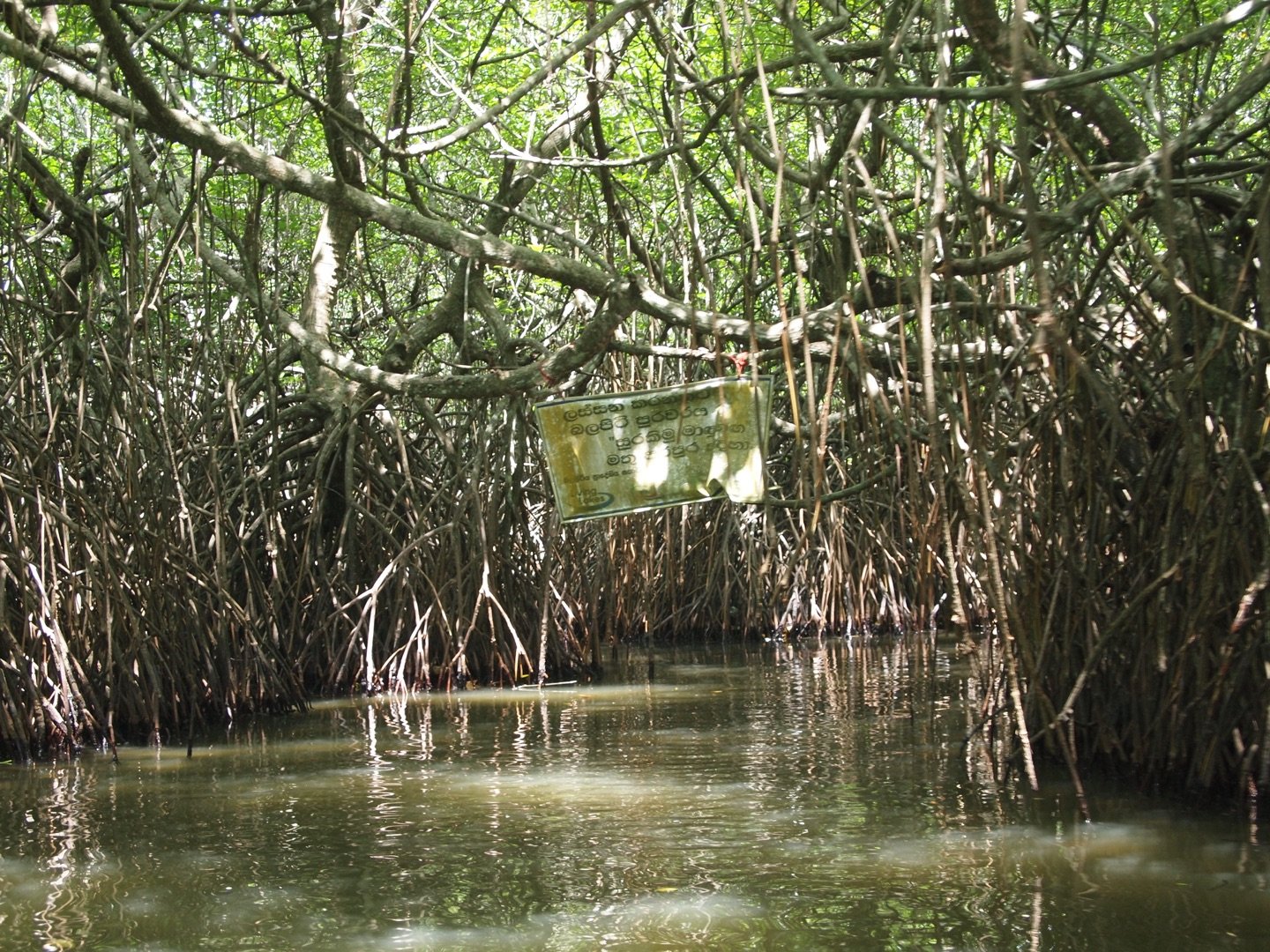
Mangroves grow in coastal conditions where wet, muddy soils can contain little oxygen. Their roots, leaves and soils support different parts of the wetland. Look below the canopy as well as into the branches: much of the habitat lies near or beneath the waterline.
Below the branches, tangled roots create places for small fish and invertebrates to find food and shelter. The habitat continues beneath the surface, even when the water hides it from view.
Madu Ganga’s 2003 Ramsar information sheet describes prawns that spawn at sea and enter the lagoon as young stages when its mouth is open. They feed and shelter among mangrove roots before moving seawards as they grow.
Fallen leaves and branches become part of the wetland’s food web. Microorganisms break down this material, returning nutrients and creating food for small organisms. Mangrove life depends on these connections as well as on the trees we can see.
Mangrove roots slow moving water, allowing suspended sediment to settle around them. This helps build the muddy ground and reduce shoreline erosion. Look at the root network from the boat and leave banks and young plants undisturbed.
Ramsar recognises Madu Ganga’s role in storing water during monsoon rains. This temporary retention links the wetland to surrounding communities as well as wildlife. Water levels also depend on rainfall and whether the lagoon mouth is open; wetland storage does not prevent every flood.
A study published in February 2026 measured organic carbon in mangrove soils at Madu Ganga and Madampa Lake. Samples reached 90 centimetres below the surface, showing why conservation needs to consider the ground beneath the trees too.
The researchers found that soil carbon stocks vary with plant communities and soil conditions. This research measures stored carbon; it does not calculate a carbon offset for an individual boat safari.
Rhizophora apiculata has arching stilt roots that enter the soft mud. A long seedling can develop while still attached to its parent tree, giving you another feature to look for when conditions allow.
Bruguiera gymnorhiza develops knee-shaped roots that bend above the mud. The shape is a useful comparison with the larger arches of stilt-root mangroves.
Kirala (Sonneratia caseolaris) produces upright breathing roots, rounded fruit and flowers that open at dusk. During a daytime visit, focus on the roots, leaves and fruit that are visible.
Gin Pol is a mangrove palm with tall, feather-like fronds rising from a creeping stem hidden below the ground. When present, its rounded clusters of brown fruits are another useful clue. It is recorded in historical Maduganga wetland surveys; sightings depend on the route.
Its fronds look very different from a mangrove with arching roots. The IUCN report records a Nypa palm-swamp assemblage at Maduganga, but that historical record does not guarantee a palm stand will be accessible on your safari.
Rathamilla (Lumnitzera littorea), also written Rathmilla or Ratha Milla, has red flowers and thick leaves. It is classified as Critically Endangered in Sri Lanka’s 2020 National Red List. Research published in 2022 records it at both Madu Ganga and the Bentota estuary, and describes low regeneration in the mature Madu Ganga population. Its conservation story extends beyond a single river: protecting remaining trees and young plants matters. Flowering and access to a suitable viewing point depend on the season and route.
Its red flowers are bird-pollinated. An identified tree can be interesting even without flowers: ask about its leaves and habitat, and leave flowers, fruits, seeds and branches in place.
Try finding one root arch, one bird perch or one leaf shape that differs from the others. If high water hides the roots or a stand cannot be reached, photographs can help your guide explain the same story. Keep hands inside the boat and avoid stepping into roots or seedlings for a closer picture.
The Private Madu River Birdwatching Safari gives your party more time for quiet cruising and observation pauses. Tell us whether you are new to birdwatching or have particular interests. Standard and Private river safaris also pass through the wetland, with more of their time planned around the included stops.
No. We provide the opportunity to observe the wetland, while animals move freely. Follow your guide's instructions and watch without feeding, touching or disturbing wildlife.
Bring your own binoculars if you would like to use them. Check the equipment listed for your selected package; binoculars are not included in the base birdwatching fare.
No fixed tree stop is promised. Tell us your interest before booking so we can explain what can be shown responsibly on the route.