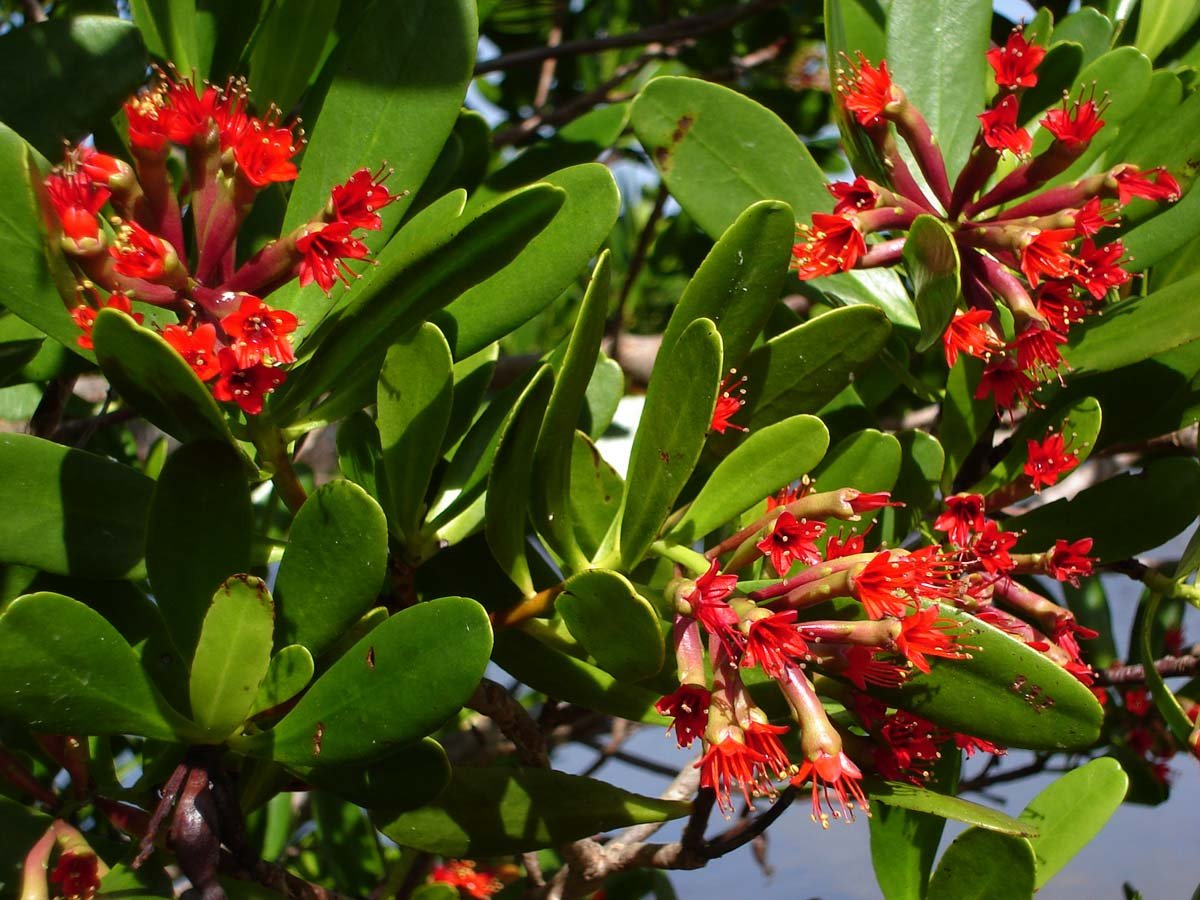
What is Rathamilla?
Rathamilla, also written Rathmilla or Ratha Milla, is a true mangrove in the Combretaceae family. Sri Lanka's national mangrove guidelines record its Sinhala name as රත්මිල්ල. Kew recognises Lumnitzera littorea (Jack) Voigt as the accepted scientific name.
It is native to Sri Lanka and a much wider region extending through parts of tropical Asia to the western Pacific. Calling it a tree found only at Madu River, or only in Sri Lanka, would therefore be inaccurate. Its importance here comes from the rarity and conservation needs of its Sri Lankan populations.
How to recognise this red-flowered mangrove
The most striking feature is its bright red flowers. The leaves are slightly fleshy, generally broadest towards their rounded ends, while older bark becomes dark and fissured. Singapore's National Parks Board describes the species as occurring mainly towards the back of mangrove forests and producing upward-growing breathing roots. Its red flowers are bird-pollinated.
Flowers can help with identification when present, but a red bloom alone is not enough to identify a tree reliably. Ask a knowledgeable guide to explain the leaves, roots and surrounding habitat too. No flowering calendar or guaranteed display is offered here: a photograph of a flowering tree does not mean every visit will find one in bloom.
Why Rathamilla matters in Sri Lanka
The Ministry of Environment's national mangrove-restoration guidelines list Lumnitzera littorea as Critically Endangered in Sri Lanka, using the National Red List 2020. This is a national assessment; it should not be presented as the species' worldwide conservation category.
At Madu Ganga, researchers have reported an ageing population with limited natural regeneration. The conservation question extends beyond whether mature trees survive today: successful seedling establishment is also needed for a population to persist. This makes the species a useful introduction to the patient, long-term work involved in conserving mangroves.
A documented conservation history at Madu Ganga
A 2019 Ceylon Journal of Science study examined the Madu Ganga population, its associated mangroves and barriers to seed germination. It reported an aged population with low regeneration, establishing a clear need for conservation research.
In 2020, University of Peradeniya researchers published experiments on vegetative propagation. Air-layering produced roots or early rooting responses in some branches, while stem cuttings did not develop adventitious roots under the tested conditions. The findings describe a research experiment, rather than an invitation for visitors to collect branches or attempt propagation themselves.
A 2022 University of Peradeniya research abstract added an important update: alongside the mature Madu Ganga population, researchers documented a younger population in the Bentota estuary. Older descriptions calling Madu Ganga the only known Sri Lankan location need that qualification. Published study counts are historical observations, not a live census for planning a safari.
Responsible viewing on a Madu River safari
If mangrove plants are a priority, mention your interest when arranging your Madu River boat safari. Ask what can be viewed along the agreed route. A botanical interest should guide a conversation with your boat operator; it should not be treated as a promise of access to a particular tree.
Keep photographs to the agreed viewing area, avoid disturbing roots or branches, and leave flowers, fruits and seeds in place. Do not step into mangrove habitat to improve a photograph. A careful explanation of the wetland can be valuable even when Rathamilla is not visible. Explore our Safari Packages page to choose your boat trip and add any nature interests to your booking details.
Rathamilla questions
Is Rathamilla found only at Madu River?
No. It has a broad native range outside Sri Lanka, and a 2022 Sri Lankan study also documented a population in the Bentota estuary. Madu Ganga remains an important documented conservation location.
Can I be sure of seeing Rathamilla flowers on my safari?
No. Neither an individual tree sighting nor flowers can be guaranteed. Ask about the practical route before booking and enjoy the wider mangrove habitat during your visit.