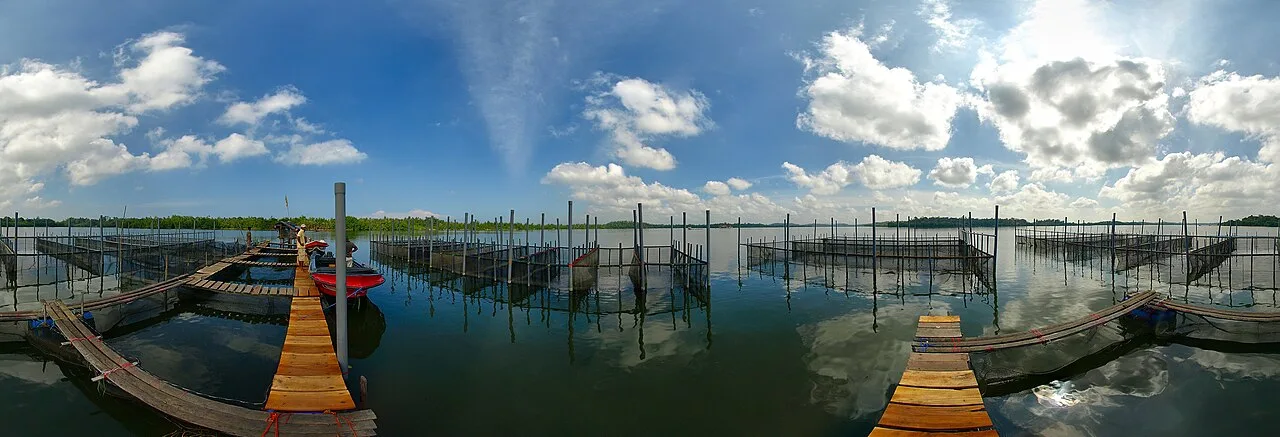
The river's fishing history comes first
Fishing belongs to the working history of Maduganga. IUCN's 2002 biodiversity assessment records fishing communities and a mixture of freshwater, brackish-water and marine fish in the estuary. This helps explain why fish are central to the wetland's ecology and local livelihoods.
The assessment is a historical ecological study, not a current stock list for a visitor attraction. A modern fish-spa platform should not be described as an ancient local therapy or treated as representative of every fishery on the river. Learning about the estuary's fish and observing a tourism activity are different ways of encountering the same water landscape.
Fish farm, fish viewing and fish spa: the differences
A fish farm normally refers to fish being raised or kept under managed conditions. A viewing stop is an opportunity to observe a facility or platform from the boat or a landing. A fish spa describes an activity in which a person immerses their feet with fish. Ask which of these the itinerary actually includes.
Names on tour listings are not enough to establish the fish species, the site's purpose or the participation conditions. This guide does not identify a particular provider, promise that feeding is available or assume that every platform has the same facilities. The useful question is what you will see and what you would be choosing to do.
Optional participation and health considerations
Watching a fish-spa stop does not require putting your feet in the water. Decide separately about participation, and ask the provider about hygiene arrangements, fish welfare, accessibility and any additional charge before starting. You can enjoy the river journey without taking part.
The US Centers for Disease Control and Prevention identifies sanitation and infection concerns with fish pedicures because fish cannot be disinfected between customers and tubs cannot be sufficiently cleaned while the fish are present. A fish spa should not be presented as medical treatment or a guaranteed health benefit. Read the current public-health guidance and seek individual medical advice if you have a relevant health concern.
Respect the wider Madu Ganga wetland
Maduganga is a Ramsar wetland whose lagoons support fish habitat and local livelihoods. A visitor stop sits within that larger ecosystem. Keep food wrappers and other litter out of the water, follow the boat crew's instructions, and avoid handling, chasing or feeding wildlife unless the activity is specifically supervised and appropriate.
The river's appeal also lies between the named stops: changing water channels, mangrove edges and daily life along the banks. Give these quieter parts of the trip your attention. A fish-spa platform is one optional experience within a broader Madu River safari, not the measure of the wetland's value.
Check your safari before booking
Read Safari Packages for the planned route, duration and included stops. Check whether the fish-related visit is a viewing stop and whether any participation is paid separately. If you are travelling with children, ask the provider about suitability and supervision instead of assuming that one rule applies everywhere.
You can then choose the package for the complete journey: mangroves, island culture and the experiences your group wants to share. Current safari prices and booking options belong on the package page, while any optional activity should be explained before you commit to it.